
Insights
Feb 22, 2026
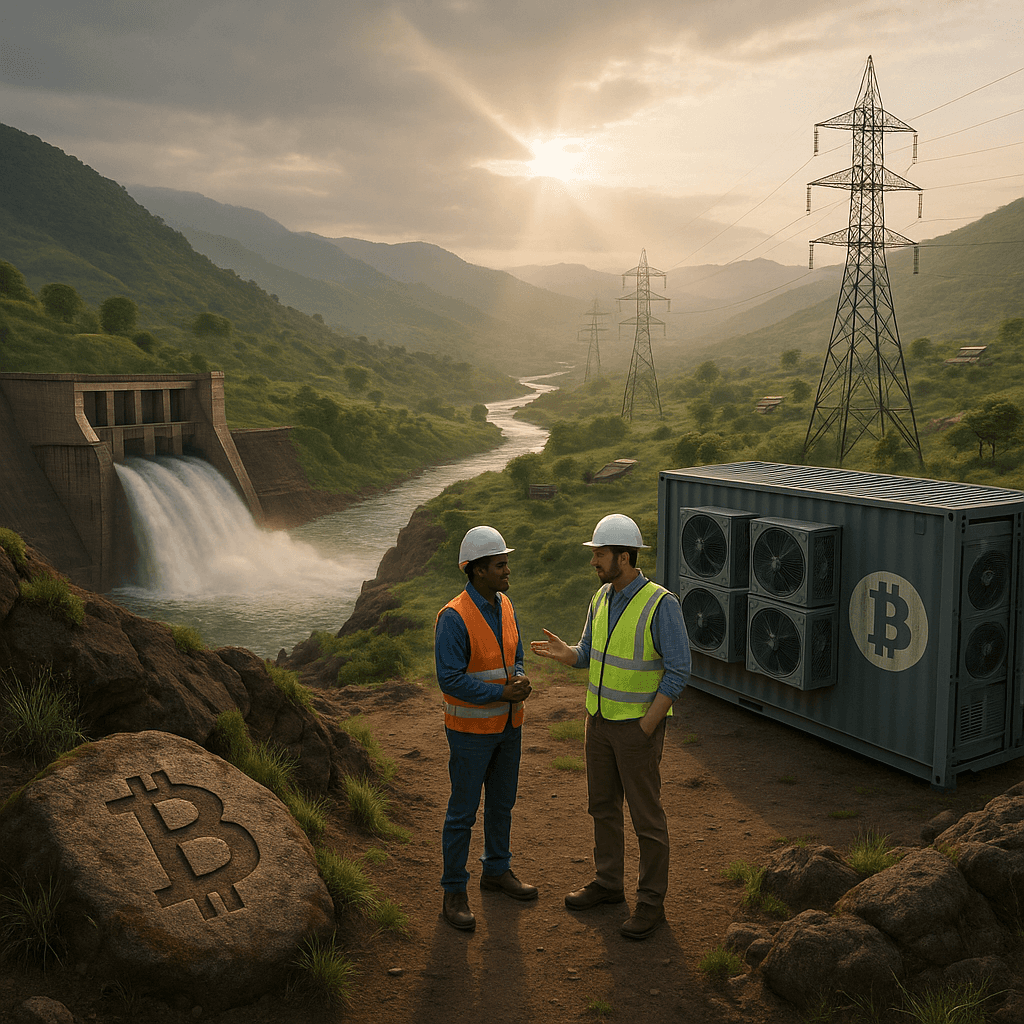
Ethiopia Calls Bitcoin Mining Temporary — But It May Be Building the Future Photo by: Midjourney
In September 2025, Ethiopian officials described Bitcoin mining as a “temporary opportunity” — a way to make use of surplus hydropower while the country continues to build out its domestic energy grid. This language, reported by BitcoinKE, cast the mining sector as a stopgap — useful for now, but not part of Ethiopia’s long-term development plan.
At first glance, that sounds prudent. Ethiopia has built a significant overcapacity in renewable power — especially hydroelectric — and much of that energy is going unused due to limited grid infrastructure and industrial demand. Rather than let it go to waste, the government has invited Bitcoin miners to lease energy, providing hard currency inflows without the debt burdens that often come with foreign investment.
But another piece of reporting from Mariblock reveals a more layered picture — one in which Bitcoin mining is not just exploiting a temporary inefficiency, but actively helping to fund Ethiopia’s energy ambitions.
According to Mariblock, the Ethiopian Investment Holdings (EIH), a state-owned sovereign wealth fund, is deeply involved in coordinating Bitcoin mining agreements. These deals bring in capital that can be reinvested in energy expansion — especially transmission lines and local infrastructure that would otherwise take years to finance.
There’s a paradox here: the same activity the government calls temporary may, in fact, be enabling the permanent progress it seeks.
This tension — between the short-term label and the long-term impact — is not unique to Ethiopia. Around the world, Bitcoin mining is emerging as a novel kind of buyer: a buyer of last resort for energy that would otherwise be wasted, and a buyer of first resort that helps justify new investment.
We’ve seen this in regions as different as rural Texas, Iceland, and Paraguay. Bitcoin miners move to the margins — places with excess supply but limited connectivity. They monetize that surplus, often paying higher-than-average rates, and in doing so, create a financial bridge that makes more ambitious infrastructure possible.
In Ethiopia, the potential is vast. The country has already attracted over 30 mining companies, many of them Chinese, to its energy-rich regions like the Oromia and Sidama states. These miners are operating under government licenses, often with high security and in relatively remote areas. Their payments — sometimes in hard currency, sometimes through local partnerships — offer the state both revenue and leverage. Ethiopia is not borrowing to build its energy future; it’s selling power in real time.
Still, the official rhetoric remains cautious. EIH and other government spokespeople continue to frame mining as temporary — a phase that will end once local demand catches up.
This raises a bigger question: what if the very thing being treated as temporary is, in fact, foundational?
Bitcoin mining may start as a patch — a way to mop up excess supply — but it tends to grow roots. It pays for roads. It creates jobs in logistics and maintenance. It draws interest in data infrastructure and fiber optics. And critically, it can remain flexible — ramping up or down in response to grid needs, acting as a kind of economic sponge that absorbs volatility.
More importantly, it introduces a new way of thinking about value. Not just electricity as fuel, but electricity as stored potential — as something that can be exported digitally, converted into a monetary network not controlled by any one state.
That part may be harder for central planners to accept. Bitcoin, after all, does not negotiate. It does not bend to policy. It pays for what it uses, and moves on if terms change. It offers capital without compliance.
For governments used to controlling every part of the investment cycle, that’s both a blessing and a challenge.
So it makes sense that Ethiopia is hedging its language. It wants the benefits without the long-term commitment. It wants to keep its options open.
But history shows that some bridges become roads. What begins as temporary often lays the groundwork for permanence — especially when it proves itself useful, scalable, and hard to replace.
In the end, Ethiopia’s relationship with Bitcoin mining won’t just shape its energy future. It may shape how it engages with the global monetary system — whether it continues to rely on slow-moving aid and debt arrangements, or begins to build with tools that move at the speed of code and capital.
To dismiss mining as a passing phase is to overlook its potential as a catalyst.
Temporary or not, something is taking root in the highlands — where water flows fast, power runs deep, and a new kind of economy is quietly plugging in.