Decoding the Bitcoin White Paper w/ Pierre Rochard
Pierre Rochard updates the 2008 white paper for 2024 Photo by: Bitcoin Whitepaper
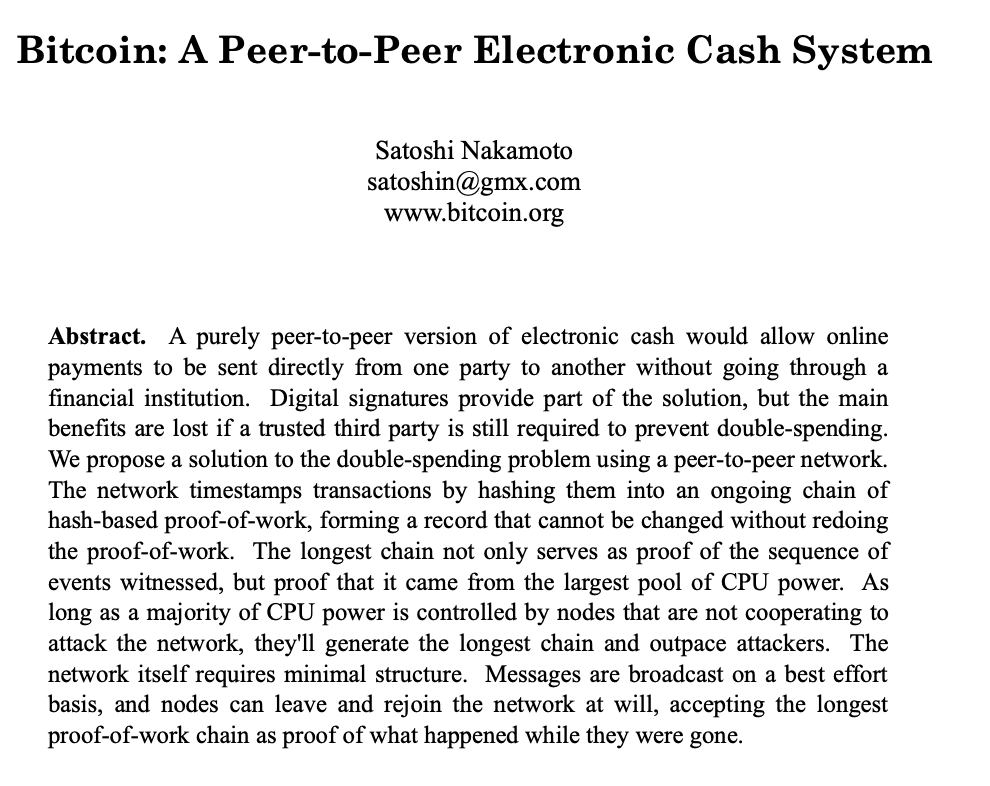
A line-by-line walkthrough of Satoshi’s 2008 white paper, updated with 2024-era context. Pierre frames Bitcoin as a trust-minimizing system that solves double-spend via a peer-to-peer timestamp server powered by proof-of-work (PoW).
Timeline matters: Satoshi likely wrote most code in 2006–2008 and published the paper on Oct 31, 2008; Bitcoin wasn’t a reaction after the GFC—more a coincidental overlap.
Genre check: The white paper is a technical note, not a manifesto or exhaustive spec. It spotlights two pillars: transactions and PoW/timestamping.
“Cash” ≠ paper money: “Electronic cash” means final settlement without counterparty risk, not just small point-of-sale spend.
Root problem is trust: Traditional rails require trusted third parties (banks/card networks). Chargebacks, fraud costs, and data leakage are side-effects of that trust model.
Double-spend fix: Make all transactions publicly announced and agree on one global ordering (the “history”). The earliest valid spend wins.
Timestamp server → blockchain: Hash data into blocks, chain them, and use PoW so changing history requires redoing the work (practically infeasible once confirmations accrue).
Most-work, not longest: Modern framing: the valid chain is the one with the most cumulative work, not merely the most blocks. (Pierre flags this as a correction to the paper’s “longest chain” shorthand.)
Difficulty adjustment: Every 2016 blocks (~2 weeks) nodes retarget the PoW threshold so blocks average ~10 minutes despite hardware swings.
Roles unbundled:
Wallets craft transactions.
Mining pools assemble candidate blocks and coordinate hashers.
Miners (hashrate providers) perform PoW.
Full nodes enforce rules, validate blocks/txs, and decide chain validity.
Security threshold: Paper says majority hashpower must be honest; later research (e.g., selfish mining) shows nuanced attacks, but in practice the system remains robust.
White paper ≠ scripture: Some details evolved; reality is what nodes actually run.
Fun bits: Early code dabbled with decentralized eBay/poker. Hal Finney’s Nov 2008 reply: “very promising idea.”