

Boyapati Says Bitcoin Still Early
Bullish case for Bitcoin Photo by:
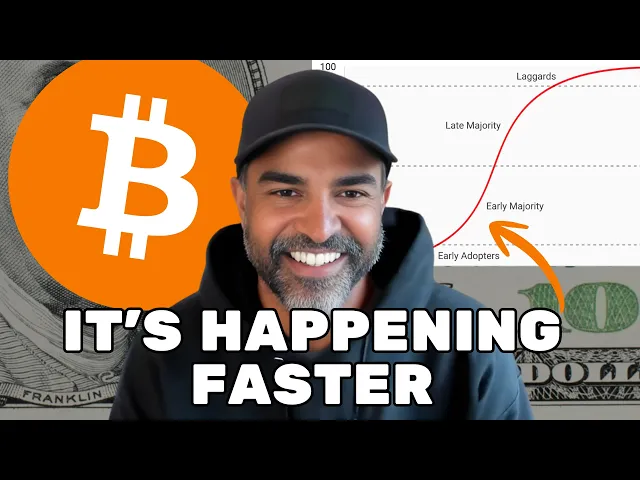
Vijay Boyapati, author of The Bullish Case for Bitcoin, argues that Bitcoin’s journey from niche collectible to global monetary asset is following a recognisable pattern, even if its timeline still has decades to run. In a January 2026 episode of Bitcoin for Millennials, Boyapati returned to a thesis he first published in 2018 and later expanded into a 2021 book, the idea that “money” is not a static definition but an evolutionary process.
At the centre of Boyapati’s framework is a four-stage path that market-driven monies tend to follow: collectible, store of value, medium of exchange, and unit of account. The key claim is that the longest and most contested phase is the transition into a broadly held store of value, because that is where trust is earned, distributed, and reinforced. Gold, he notes, did not become monetary because it was “useful” in an industrial sense, it became money because humans collectively decided it was worth holding, then kept acting on that belief for centuries.
Boyapati’s core point for 2026 is blunt: Bitcoin has not “arrived” as a fully established store of value yet, it is still becoming one. He frames the early years, 2009 to 2010, as a collectible phase with limited price discovery and a small, technically literate holder base. He then describes 2011 through roughly 2020 as the period where Bitcoin began acting as an “incipient” store of value, with widening ownership, maturing infrastructure, and repeated market cycles that forced participants to test their conviction.
That framing matters because it sets expectations. Boyapati is sceptical of rigid adoption models and price-based “laws”, not because adoption is random, but because monetisation is shaped by psychology, narratives, and the churn of weak hands into strong ones. He describes “path dependence” as the habit of anchoring beliefs to recent price history, a dynamic that can make Bitcoin seem like a scam after a drawdown, or “too late” after a rally. His argument is that this is precisely what you should expect from an asset that is monetising without cash flows, while still fighting for legitimacy in public consciousness.
In 2026, institutionalisation is no longer theoretical. The United States Securities and Exchange Commission approved the listing and trading of spot bitcoin exchange-traded products in January 2024, a landmark that brought Bitcoin exposure into mainstream brokerage rails. Boyapati treats this as an inevitable stage of adoption rather than a betrayal of early cypherpunk ideals. His view is that Bitcoin’s promise is not to keep “the right people” out, but to keep its rules consistent. If the asset is neutral and cannot be inflated, then, over time, it pressures institutions to adapt to it, rather than the other way around.
This is also where Boyapati’s comparison with gold becomes sharper. He argues that Bitcoin is “obviously superior” to gold as a store of value, particularly on portability, verifiability, and settlement finality. In the episode, he points to the real-world friction of moving physical metal, the risks of transport and custody, and the persistent challenge of authentication. The interview references a widely shared clip where Changpeng Zhao challenged gold advocate Peter Schiff with the practical problem of verifying a gold bar’s authenticity, highlighting that certainty in gold often requires destructive or specialist testing.
Yet he also warns against dismissing gold’s network effects. Central banks are still buying gold in size, and recent data underlines that reality. The World Gold Council reported central banks added 1,045 tonnes in 2024, marking a third consecutive year above 1,000 tonnes. While official-sector buying cooled in 2025 to 863.3 tonnes, it remained far above the 2010–2021 average, and broader investment demand surged. In other words, gold’s “brand” is real, and it is still being reinforced by sovereign reserve behaviour.
Boyapati’s thesis, however, is that network effects can be unseated when a challenger offers a massive comparative advantage. Bitcoin does not need to be marginally better than gold, it needs to be so much better that, at the margin, more people decide they must hold it. He argues that this is happening unevenly across the world, especially where individuals face confiscation risk, capital controls, or regime instability. Bitcoin’s pitch in those contexts is not abstract ideology, it is the practical ability to move value across borders without asking permission.
The interview also touches on a crucial, under-discussed mechanism of monetisation: distribution. Bitcoin’s ownership was historically concentrated among early adopters, and the asset cannot become a widely held monetary good unless early holders sell to later buyers. Boyapati points to the psychology of round-number price levels, arguing that $100,000 acted as a distribution trigger for some long-term holders. This theme gained credibility in 2025 as on-chain watchers tracked a large, dormant holder moving tens of thousands of bitcoin to Galaxy Digital, which later sold more than 80,000 bitcoin on behalf of an unnamed early investor, an exit worth roughly $9.3 billion at the time. Notably, the market absorbed the flow without the kind of disorder that defined earlier cycles, a sign, at minimum, that liquidity and buyer depth have matured.
On nation-state adoption, Boyapati maintains a nuanced stance. He argues sovereign accumulation would meaningfully accelerate Bitcoin’s legitimacy as a store of value, broadly analogous to central banks buying gold, but he is cautious about timing. He suggests highly centralised political systems may move first because executive power can act quickly, while polarised democracies move slower because major decisions become partisan battlegrounds. The implication is that Bitcoin’s reserve trajectory may be shaped less by “who understands it” and more by which regimes can act decisively under pressure.
For Bitcoin’s role in macro markets, the interview stays focused on fundamentals rather than forecasts. If Bitcoin is superior money and its comparative advantage persists, then adoption should continue, albeit in volatile bursts. As of February 4, 2026, bitcoin is trading around $76,266, underscoring Boyapati’s broader point that price is a noisy signal during monetisation, not a verdict on whether the asset’s monetary thesis holds.
Boyapati’s closing message is not that Bitcoin’s endgame is imminent, but that the direction of travel is becoming clearer. Store-of-value monetisation is still underway, and the unit-of-account stage remains distant, but the infrastructure, institutional rails, and global awareness that underpin those later phases are now materially stronger than they were even a few years ago. In that sense, the argument from 2018 is less about “what happens next” and more about what it means when an immutable monetary network keeps surviving, expanding, and distributing itself into new hands.