Insights
Feb 22, 2026
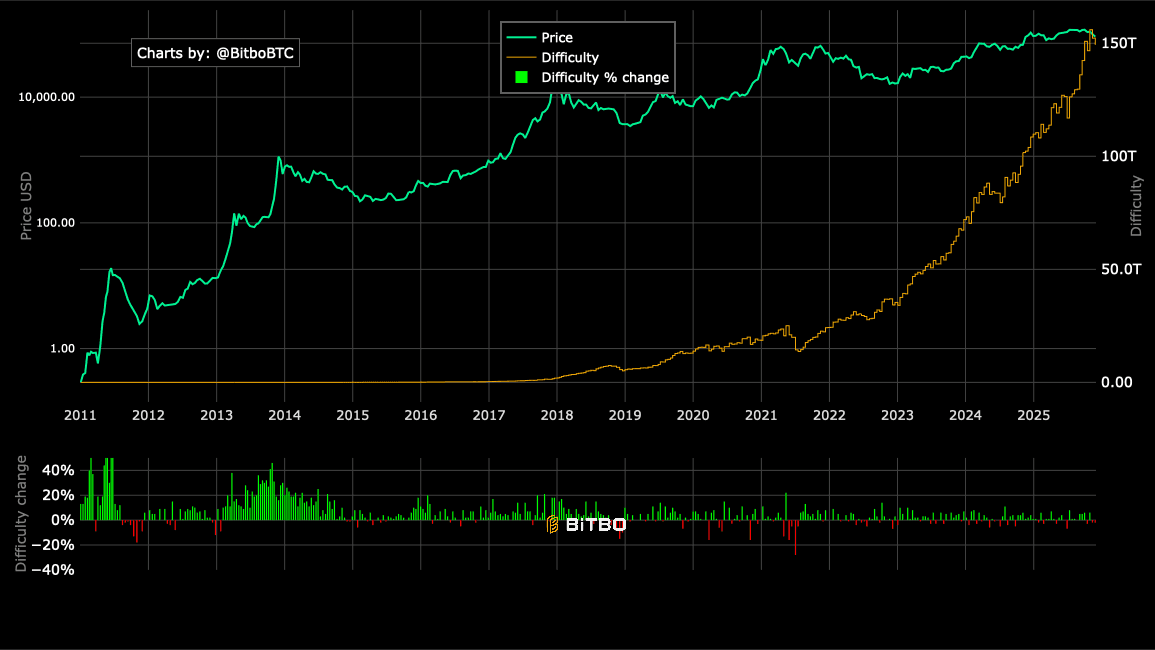
Bitcoin difficulty adjustment since 2011 Photo by: Bitbo
Every 10 minutes, the Bitcoin network aims to produce a new block, no faster, no slower. It doesn’t matter if thousands of new miners join the network or if entire regions shut down mining operations overnight. Bitcoin adjusts.
This consistency is the result of one of Bitcoin’s most underrated innovations: the difficulty adjustment.
What it does
Bitcoin's protocol targets a steady rhythm: one block every 10 minutes. But mining is competitive, and the more computing power (hashrate) miners add, the faster blocks would naturally be found. Left unchecked, this would distort the fixed issuance schedule and undermine trust in Bitcoin’s monetary supply.
To prevent this, Bitcoin recalibrates the difficulty of its cryptographic mining puzzle every 2016 blocks, roughly every two weeks. If blocks were coming too fast, it raises the difficulty. If they were too slow, it lowers it. This adjustment happens automatically, without human intervention.
Why it matters
The difficulty adjustment preserves Bitcoin’s monetary discipline. It ensures new coins are released in line with the programmed schedule, keeping the supply predictable regardless of external shocks.
It also reinforces network resilience. In 2021, when China banned mining and more than half the global hashrate went offline almost overnight, the network slowed, but only briefly. Within two weeks, difficulty adjusted downward and the system resumed normal operation.
Finally, it guarantees neutrality. No miner, company, or government can manipulate how quickly new Bitcoin is issued. The system responds solely to real-time conditions, hashrate in, block time out.
The broader impact
Without difficulty adjustment, Bitcoin would be unstable. Blocks might arrive erratically, transactions would backlog, and trust in the system would falter. Instead, Bitcoin behaves like digital physics, self-correcting, decentralised, and immune to manipulation.
This makes the difficulty adjustment not just a technical feature, but a core pillar of Bitcoin’s credibility as a global monetary system.