

Learn
Jan 9, 2026
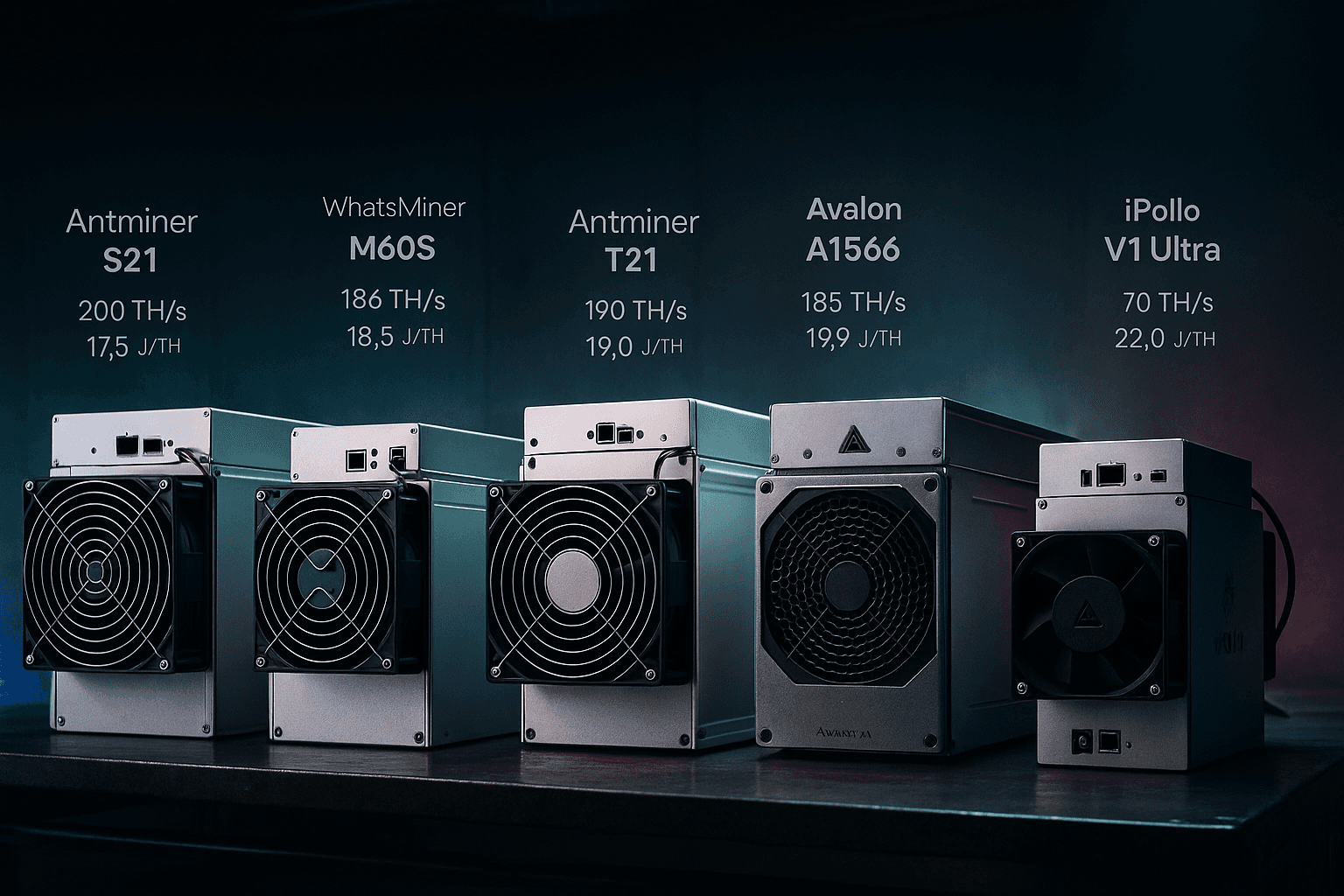
Five Bitcoin Miners That Matter in 2025 Photo by: ChatGPT
As of September 2025, Bitcoin’s network hash rate is holding at historic levels. Long-term averages sit around 635 exahashes per second, while real-time estimates have surged above 1.2 zettahashes (1,200 EH/s). Whether you follow the smoother trendlines or the sharper peaks, the story is the same: the network is stronger than ever, and competition to mine the next block has never been tougher.
This sustained surge doesn’t just reflect network growth. It reflects a mining industry deep in its post-halving phase — where rewards are halved, difficulty is high, and the room for error is shrinking. For those still stacking sats with hardware, the choice of ASIC isn’t just a matter of specs anymore. It’s a question of survival.
In this environment, the miner you choose needs to do more than hash efficiently. It needs to hold up over time, handle heat, manage uptime, and deliver a stable return in a market where electricity is often your biggest cost. Spec sheets are a starting point — but real-world performance, durability, and context shape profitability in the long run.
Here’s a grounded look at five of the most relevant Bitcoin miners on the market in 2025 — considering not just theoretical performance, but what these machines actually mean for operators in different setups, from home mining to industrial-scale farms.
186 TH/s | ~18.5 J/TH | ~$2,250 new
MicroBT’s flagship is no longer the most efficient on the market, but it remains one of the most reliable. Built to last, with strong thermal performance and consistent uptime. A solid choice for industrial setups with low power costs.
200 TH/s | ~17.5 J/TH | ~$2,450 new
Bitmain’s S21 leads on efficiency and raw power. At 17.5 J/TH, it’s among the best in class — but sensitive to heat and dust, which makes environment a factor. Best suited for optimized, climate-controlled facilities aiming to maximize profit per watt.
185 TH/s | ~19.9 J/TH | ~$1,800 new
Canaan’s latest Avalon is a no-frills, budget-conscious option. Slightly less efficient, but attractively priced. Less common in North America, but used widely in Asia and flare-gas setups. Durable and simple, but needs cheap power to stay viable.
190 TH/s | ~19.0 J/TH | ~$1,950 new
Bitmain’s more affordable sibling to the S21. Offers strong output for the price, but gives up a bit on efficiency. A popular pick for scaling fleets on a tighter budget — especially in mixed-load operations where not every machine needs to be top-tier.
70 TH/s | ~22.0 J/TH | ~$1,050 new
Low-power, compact, and designed for home or small-scale use. It won’t win any hashrate races, but it sips electricity and runs quieter than most. Not for large farms — but for hobbyists with cheap power, it’s an accessible entry point.
In a post-halving landscape where margins are thinner and the arms race for efficiency is slowing down, no single miner stands above the rest in every category. Each machine here represents a different tradeoff — between cost, power, environment, and scale. For some, the right move is stacking top-tier rigs in a controlled data center. For others, it’s squeezing value from older models or quiet units at home. What matters now isn’t just speed or specs — it’s strategy.
The miner you choose should fit your electricity, your climate, your risk tolerance. In 2025, surviving the cycle means mining smarter, not just harder.