

Fiat World
Feb 22, 2026
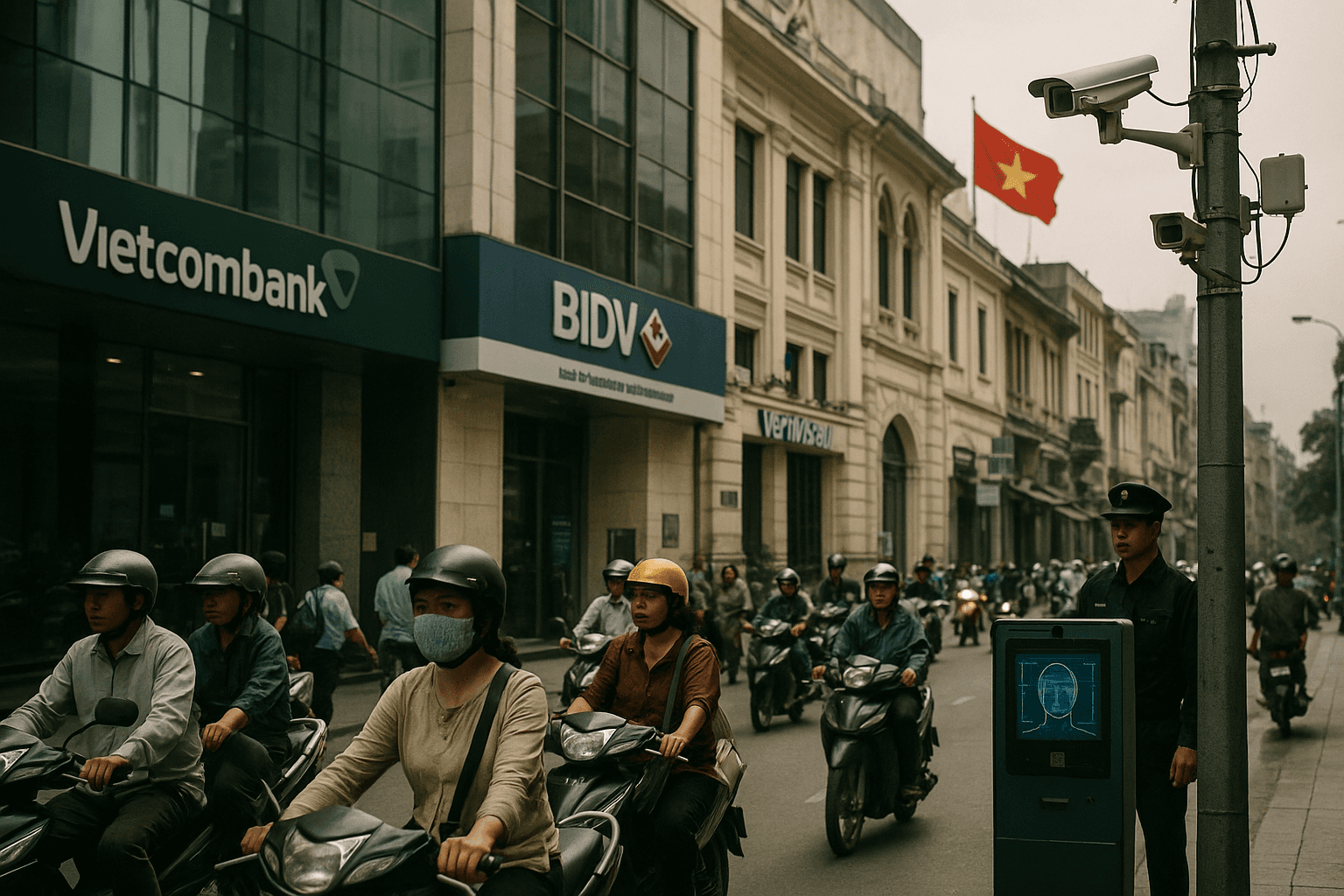
Vietnam’s Bank Account Purge: A Digital Pivot with Historical Echoes Photo by: Midjourney
Vietnam’s Bank Account Purge: A Digital Pivot with Historical Echoes
In January 2025, Vietnam’s central bank—the State Bank of Vietnam (SBV)—quietly began enforcing what would soon become one of the largest financial reorganizations in the country’s modern history. More than 86 million bank accounts, roughly 43% of all accounts nationwide, were flagged for termination. The reason? Non-compliance with a new biometric verification mandate, tied to Vietnam’s expanding digital identity system, VNeID.
At first glance, this might seem like a technical cleanup—bureaucratic hygiene in an era of rising cybercrime and digital payments. But beneath the surface lies something more revealing. The decision, and the way it was carried out, reflects Vietnam’s deeper political DNA: a system that has evolved economically since the Đổi Mới reforms of 1986, but one where the Communist Party of Vietnam (CPV) retains a firm grip on levers of power, often blending modernization with central control.
To understand what’s unfolding today, it helps to look back.
After unifying the country in 1975, the CPV launched an ambitious plan to build a socialist economy. Land was collectivized, private enterprise banned, and the financial system fully nationalized. The SBV became the sole banking authority, operating not to serve individual depositors but to channel state funds and manage quotas. Ordinary citizens had no real financial autonomy. Economic isolation, tight internal surveillance, and rigid social control were features, not bugs, of the system.
But by the mid-1980s, that system was collapsing under its own weight. GDP per capita had fallen to just $230, food shortages were widespread, and the collapse of the Soviet Union loomed. In response, Vietnam initiated Đổi Mới—a set of market-oriented reforms that opened the door to private enterprise, foreign trade, and limited personal freedoms. Since then, the transformation has been profound. Vietnam now boasts a $476 billion economy, and 87% of adults have access to bank accounts. Fintech is booming. Digital wallets and QR payments are common even in small villages.
But Đổi Mới didn’t dismantle the Party’s authority—it recalibrated it. And the 2025 account purge is a potent example of how that authority is being projected into the digital era.
The justification for the policy is straightforward on paper: to combat fraud. The SBV reported 659,000 financial cyberattacks in 2024 alone, many involving anonymous or dormant accounts. The new rule, under the umbrella of “Project 06”, requires all account holders to link their banking credentials with VNeID, which collects facial scans, fingerprints, and other biometric data. Those who didn’t comply—often because they lacked access, awareness, or legal documentation—saw their accounts frozen or deleted.
While the intent may be security, the effect is unmistakably centralizing. Much like past policies that required citizens to carry movement permits or register with local officials, VNeID consolidates personal and financial information into a single, state-managed system. It’s a digital gatekeeper. And for many, particularly in rural areas or among the Vietnamese diaspora, it has become a barrier rather than a bridge.
This digital gatekeeping is not unique to Vietnam. India’s Aadhaar, the EU’s eIDAS, and China’s social credit systemall reflect the same global impulse: to make identity interoperable, traceable, and secure. But in Vietnam, the absence of meaningful political pluralism or independent legal recourse raises sharper concerns. When a government can erase your financial identity without public debate or judicial review, the balance between security and freedom tips precariously.
The social impact is already visible. Local posts on X (formerly Twitter) tagged with #VietnamBankFreeze show anger and confusion, especially among younger, urban Vietnamese who view the policy as a digital overreach. Others warn of rising inequality, as low-tech users—many of them elderly or poor—struggle to adapt. Meanwhile, unclaimed fundsfrom deleted accounts have become mired in bureaucracy, with some former holders required to reverify their identity in person, a process that can take weeks.
There are economic risks, too. International investors, especially those aligned with OECD privacy standards, are watching closely. If Vietnam’s digital transformation is seen as a tool of coercion rather than inclusion, it could spook the very partners the country seeks to attract. Vietnam may be walking a tightrope: eager to be a hub for high-tech manufacturing and digital trade, yet still tethered to its command-and-control reflexes.
In this sense, the 2025 bank cleanup is more than a technical matter. It’s a stress test of the hybrid system Vietnam has built over four decades—a system that delivers growth and innovation, but still defaults to unilateralism when confronted with disorder.
The question now is whether the CPV can evolve further—adapting its governance to match the complexity of its society. Not just modernizing the tools of administration, but also inviting more transparency, consultation, and legal clarity in how those tools are used. Vietnam’s past shows what happens when control stifles adaptability. Its future may depend on whether it can learn from that history without repeating it.
As digital finance becomes the norm and global standards harden around data rights, the stakes will only rise. For now, the story of Vietnam’s bank account purge remains unfinished—a reflection of a country in motion, still wrestling with how to balance its revolutionary past with its increasingly networked, digital future.