

Fiat World
Feb 22, 2026
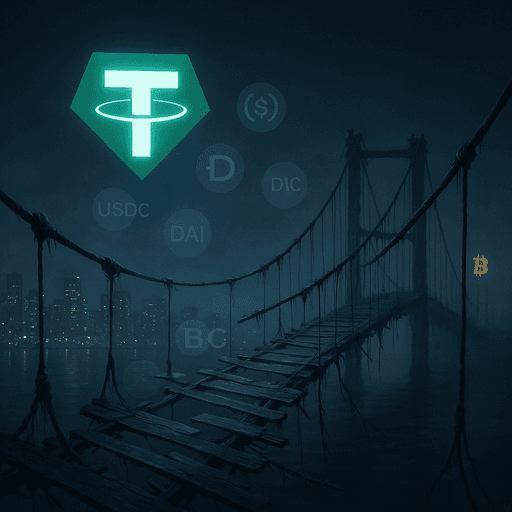
As the dollar finds new footing through digital proxies, Bitcoin quietly waits at the end of the road. Photo by: GPT
In a world increasingly defined by capital controls, financial surveillance, and debt-fueled economies, stablecoins have emerged as a curious compromise — a digital wrapper around old money. Their promise is simple: the speed and openness of crypto, with the perceived stability of fiat currencies, especially the U.S. dollar.
Now, in 2025, that compromise is starting to look more like a calculated strategy.
After years of regulatory fog, the U.S. has begun clearing the runway for stablecoins — especially those that support the dollar’s global reach. The recent Stablecoin Clarity Act, currently moving through Congress with bipartisan backing, aims to formally license fiat-backed stablecoins through regulated financial institutions. Circle (issuer of USDC) and Paxos are being shepherded into the fold. Meanwhile, Tether (USDT) — still based offshore — continues to thrive, especially in regions like Latin America, Southeast Asia, and parts of the Middle East.
It’s a strange alignment: Washington and the crypto industry both pushing dollar-backed stablecoins, albeit for different reasons. But the effect is the same — the dollar, long a symbol of American dominance, is being digitized and decentralized, not just to compete with crypto, but to harness it.
Let’s be honest: stablecoins are not stable. Not in the way people assume.
They maintain a peg to fiat, but fiat itself is unstable — backed not by scarcity, but by policy, politics, and trust. Since 2020, the U.S. money supply has ballooned by trillions. Inflation has cooled somewhat in 2025, but the structural imbalances — fiscal deficits, aging populations, geopolitical tensions — remain.
In that context, stablecoins aren’t a solution to instability. They’re a symptom. A patchwork tool to maintain trust in the dollar in places where that trust is eroding. For citizens in Nigeria, Argentina, or Lebanon, USDT is often more accessible than the official banking system — a lifeboat, not a yacht.
Here’s where it gets interesting.
Tether — long criticized for opacity — has become the most-used stablecoin in the world, with a market cap exceeding $120 billion as of August 2025. What sets it apart isn’t just ubiquity, but evolution: Tether now reportedly holds over 10% of its reserves in Bitcoin, alongside U.S. Treasuries and other assets.
That changes the story.
In a quiet way, Bitcoin is becoming the ballast inside a so-called “stablecoin.” The one asset with no counterparty risk — immune to debt ceilings, central bank pivots, and inflation targets — is being used to support a product whose entire purpose is to avoid volatility.
It’s almost poetic. The only stable part of a stablecoin… is the thing it was built to bypass.
So what’s really happening here?
At one level, the U.S. is exporting digital dollars to maintain monetary influence. It’s cheaper and faster than tanks or treaties. By encouraging regulated stablecoins, the U.S. is meeting the world where it already is: mobile-first, crypto-literate, and disillusioned with local currencies.
But at a deeper level, this feels like a transitional phase — a bridge between the collapsing trust in fiat and the slow realization of Bitcoin’s permanence.
If fiat is the past, and Bitcoin is the future, stablecoins are the present — messy, compromised, yet useful. They are training wheels for the monetary re-education that Bitcoin requires. Tools of survival in a time of transition.
And for many people, Tether is the first stop on the road to self-custody, not the final destination.
There’s a tendency in the Bitcoin world to scoff at stablecoins. And fair enough — they’re dollar derivatives, not freedom tools. But tools don’t need to be perfect to be useful. In places where banking is broken or the local currency is collapsing, a dollar-based stablecoin can be the difference between food and hunger.
Yet we shouldn’t mistake the bridge for the home.
All fiat currencies fail. They always have. The question is not if, but when, and what comes after. As governments move to digitize their control, Bitcoin remains the quiet alternative — a monetary system rooted not in promises, but in proof.
Tether may be on the rise. The U.S. may find short-term advantage in digital dollars. But in the long run, people don’t want a new version of the old system. They want an exit.
And if we’re lucky — if we prepare — they’ll find it.
Tether reserve composition (June 2025): https://tether.to/en/transparency/
Circle’s compliance with U.S. regulation: https://www.circle.com/blog
Stablecoin Clarity Act overview: https://www.congress.gov/bill/118th-congress/house-bill/1234
Bitcoin in emerging markets: Human Rights Foundation report (2025): https://hrf.org/bitcoin