Markets
Feb 22, 2026
One Bitcoin Still Equals One Bitcoin Photo by: BTCWN
On September 30th, 2025, one Bitcoin was trading for $112,911 on Coinbase. But of course, that number is only meaningful in relation to something else — in this case, the US dollar. And the dollar, like all fiat currencies, changes with time.
Five years earlier to the day, on September 30th, 2020, one Bitcoin was worth just $10,784 in dollars. That’s a tenfold rise — striking, yes. But the picture becomes clearer, and more sobering, when you extend the comparison across other currencies.
In euros, Bitcoin rose from €9,182 to €96,170 over the same five-year span. In Japanese yen, it climbed from ¥1.13 million to nearly ¥16.7 million. In Turkish lira, it soared from ₺83,253 to ₺4.7 million. And in Argentine pesos — a currency that has suffered multiple crises in that time — it leapt from ARS 821,431 to more than ARS 160 million.
These are not just large numbers. They are stories of erosion — not of Bitcoin's value, but of the purchasing power of national currencies.
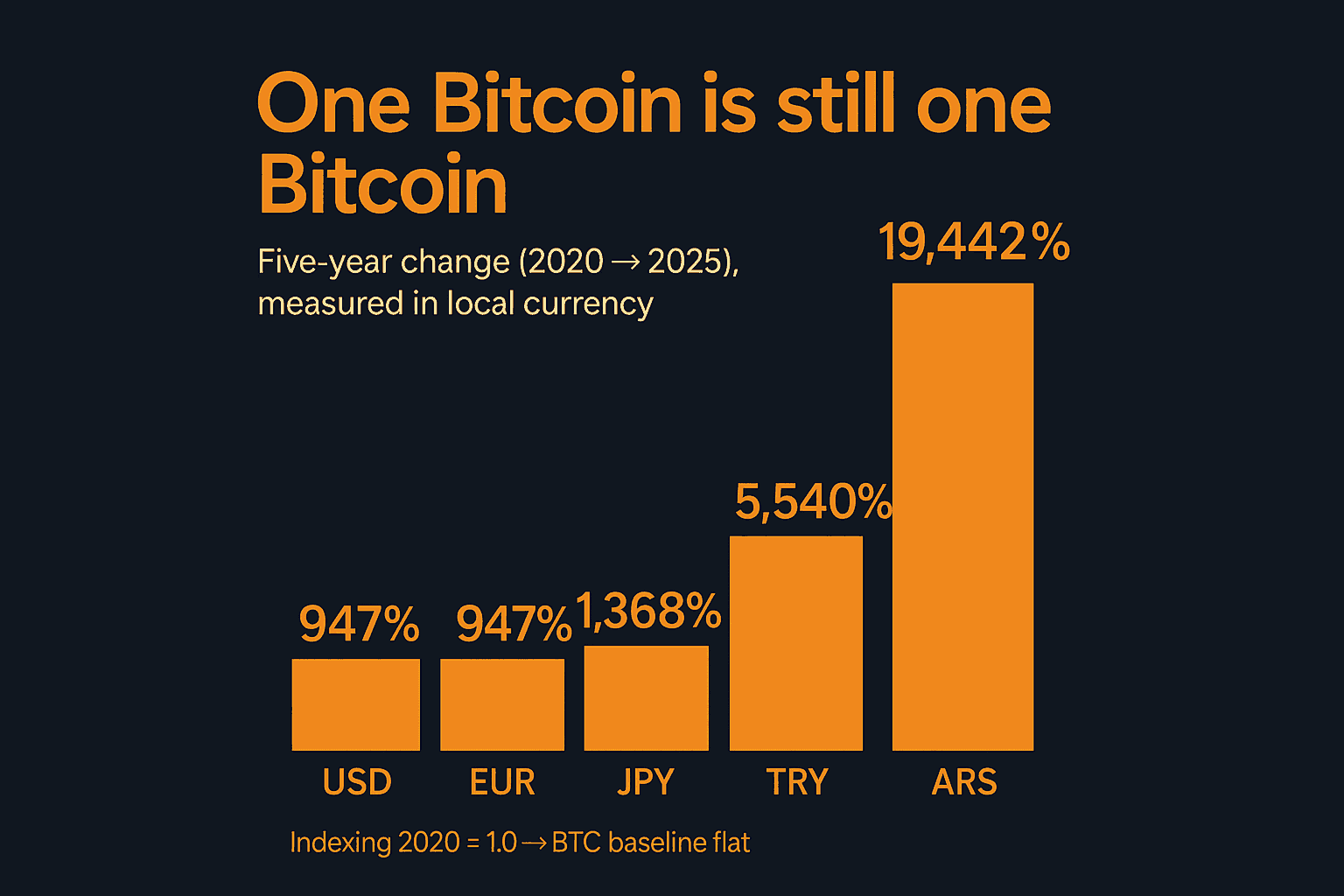
Measured in dollars, Bitcoin went up 947% over the five years.
In euros: also 947%.
In yen: 1,368%.
In Turkish lira: 5,540%.
In Argentine pesos: 19,442%.
One Bitcoin is still one Bitcoin. It hasn’t changed. What’s changed is everything else.
This isn’t a story about Bitcoin “going up.” It’s a story about fiat currencies — especially those under political or economic strain — going down. Gradually, and then very suddenly.
If you lived in Turkey or Argentina during these five years, the numbers above are not abstract. They reflect real difficulty: the shrinking power of a monthly salary, the impossibility of saving, the constant need to spend before your money loses more value. Even in Europe or the United States — where the declines are slower and masked by more stable institutions — the trend is visible. Purchasing power weakens, even if the headlines try to tell you otherwise.
Bitcoin, in this context, does something subtle but powerful: it stands still. It becomes a fixed point in a world of motion. A reference frame. Its price moves — violently at times — but the thing itself doesn’t change. It remains governed by code, not by decree.
You can argue about whether Bitcoin is too volatile to be a currency. You can question whether it's ready for widespread adoption. But what these numbers make plain is that over time, Bitcoin exposes what’s happening to the money we already use.
The price of one Bitcoin tells you less about Bitcoin than it does about the currency you're using to measure it.
And for people trying to preserve value across years — not just weeks — that difference matters.