

Fiat World
Feb 22, 2026
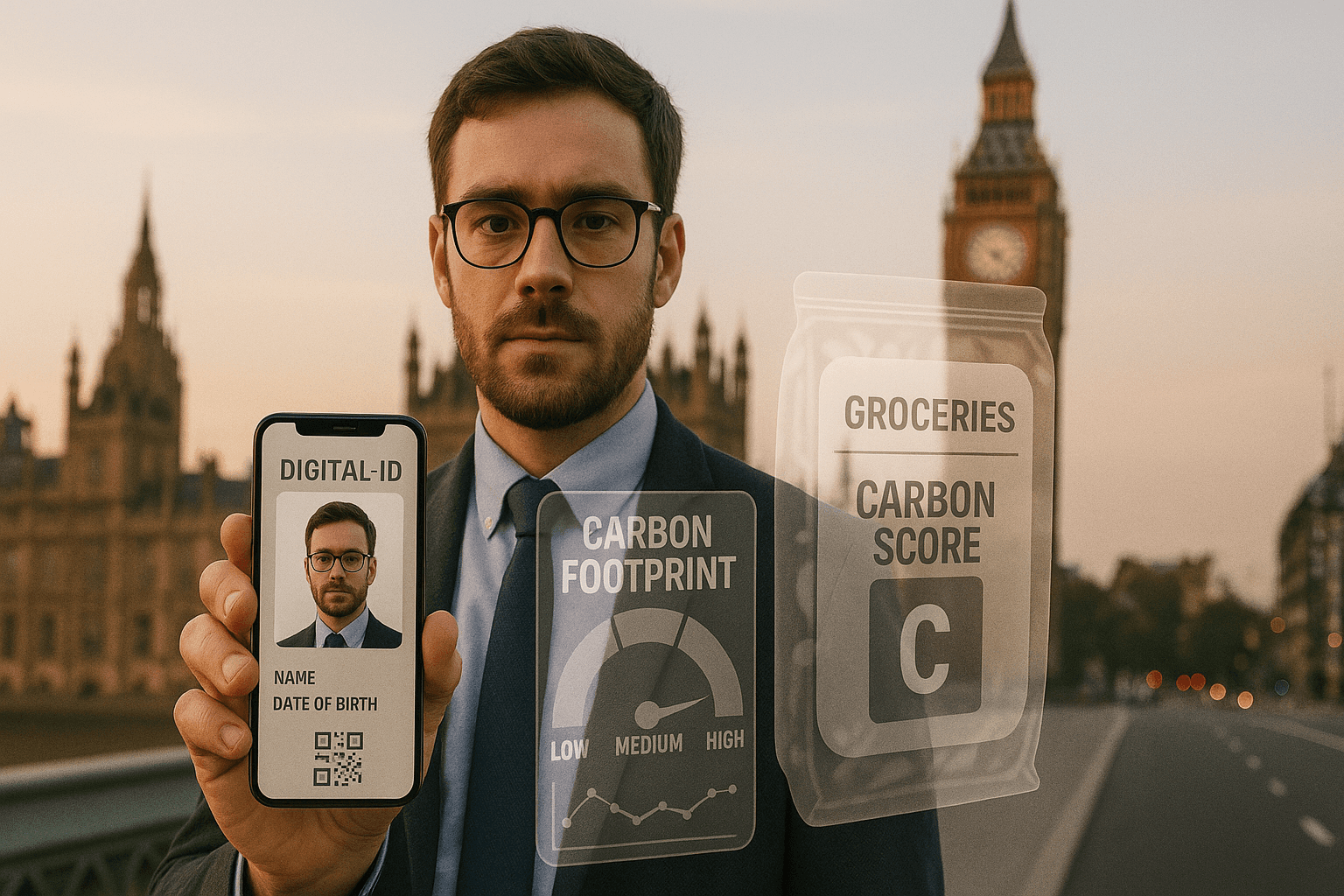
Carbon Scoring of Spending: Converging Signals of Behavioural Control Photo by: Midjourrney
The UK Government is moving swiftly to embed a new layer of identity verification into everyday life. As we reported previously, Downing Street announced that a digital identity scheme will become mandatory for right‑to‑work checks by the end of this Parliament, with implementation beginning via mobile devices and using the existing “One Login” infrastructure.
The proposed credential has been referred to as the “Brit Card” and would be held on a smartphone. The scheme is being allocated to tackle illegal working and migration, but it raises privacy and state‑control concerns. Analysts warn a centralised digital identity system could “remove much of the individual’s agency” and become an “enormous hacking target”.
In parallel to the identity initiative, behavioural and environmental monitoring tools are entering the marketplace. NatWest now offers a “Carbon Footprint Tracker” in its mobile banking app, which estimates customers’ carbon impact by analysing spending categories and applying emissions factors, e.g. estimating that a £15 clothing purchase may equate to 16 kg CO₂e.
Meanwhile, the UK food‑supply chain is undergoing evolving labelling practices: pilot schemes supported by the non‑profit Foundation Earth have placed “eco‐impact” scores on certain food and drink items, graded A+‑G, based on their lifecycle emissions, water use and biodiversity impact.
These parallel developments suggest a broader shift: identity systems that tie individuals to digital credentials, and environmental monitoring systems that tie spending and consumption to quantified carbon‑footprints. The risk is that such systems could intersect to enforce behavioural norms, e.g., limiting work access, modifying consumption, or conditioning services on compliance with identity and environmental metrics. Critics warn this may echo Chinese‑style social monitoring and entrench new forms of control.
The friction between governance, technological capability and public trust is clear. When digital‑ID proposals were widely floated, support dropped sharply, from 53 % in favour in summer 2025 to just 31 % after announcement, with 45 % opposed.
The question for Britain now is whether the convenience and fraud‑prevention benefits of these systems will outweigh the risks to privacy, autonomy and democratic oversight. If implemented without strong safeguards, the combination of mandatory digital identity plus consumption‑monitoring tools could mark a turning point in state‑citizen relations.