
Markets
Feb 22, 2026
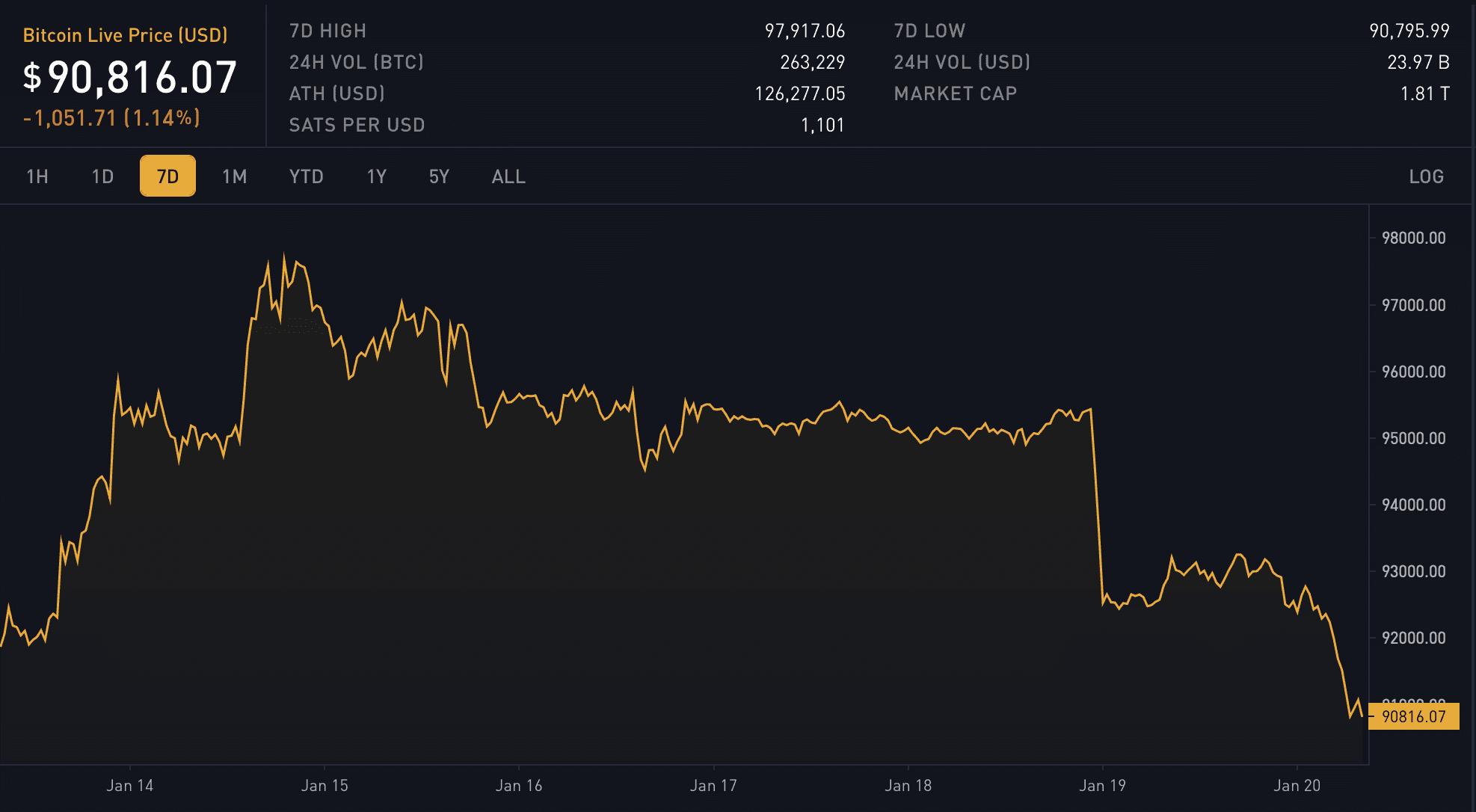
7 day chart Photo by: Bitbo
Bitcoin has retreated toward the low $90,000 range after briefly trading in the high $90,000s earlier in the week, with market participants pointing to a renewed bout of global risk aversion rather than any Bitcoin-specific shock. The move has unfolded alongside broader macroeconomic and geopolitical pressures, reinforcing the asset’s growing sensitivity to global liquidity conditions and investor risk appetite.
At the time of writing, Bitcoin is changing hands around $91,000–$92,000, down from levels above $97,000 seen only days earlier. The pullback coincided with a wider “risk-off” tone across financial markets, as equities softened and the U.S. dollar strengthened modestly. Analysts and market commentators have linked this shift in sentiment to renewed uncertainty around U.S.–EU trade relations, persistent geopolitical tensions, and an environment in which investors are reassessing exposure to volatile assets.
This pattern is not new. As Bitcoin has become more deeply integrated into institutional portfolios, short-term price action has increasingly reflected macro conditions rather than purely crypto-native dynamics. When global investors move to reduce risk, Bitcoin often trades in sympathy with technology stocks and other high-beta assets, even as its long-term narrative as a hedge against monetary debasement remains intact.
The recent dip follows a strong mid-week rally that pushed Bitcoin back toward the upper end of its recent range. That advance was largely attributed to robust inflows into U.S. spot Bitcoin exchange-traded funds, which have continued to act as a major conduit for institutional demand. Multiple days of significant net inflows were recorded during the rally, underscoring sustained interest from asset managers, pension funds, and other large allocators seeking regulated exposure to Bitcoin.
These ETF flows have become one of the most closely watched indicators in the market. Since their approval, they have helped absorb selling pressure during periods of weakness and amplified upside moves when sentiment turns positive. The rally toward $97,000 earlier in the week was widely interpreted as evidence that institutional demand remains resilient, even as macro conditions remain uncertain.
However, the subsequent pullback highlights the limits of that support in the face of broader risk aversion. While ETF inflows can provide a steady bid, they do not fully insulate Bitcoin from global market dynamics. In periods of heightened uncertainty, marginal sellers often dominate short-term price action, particularly among leveraged traders and short-term holders.
Political developments have also added noise to the market narrative. In recent days, social media discussion has circulated around claims that former U.S. President Donald Trump is considering eliminating or sharply reducing taxes on Bitcoin and other digital asset transactions if returned to office. These claims, widely shared on platforms such as X, have contributed to bouts of speculative optimism.
It is important to note that no official policy proposal, legislation, or binding commitment has been announced. At present, these reports remain speculative and should be treated as political discourse rather than established fact. While there is evidence of a more openly pro-Bitcoin tone among some U.S. political figures, concrete policy changes have yet to materialise. For markets, this distinction matters. Rumour-driven narratives can move prices in the short term, but durable trends depend on enacted regulation and clear legal frameworks.
Beyond price and politics, on-chain and network-level indicators present a more nuanced picture. Bitcoin’s hashrate has shown signs of a modest easing in recent weeks, reflecting ongoing adjustments by miners to operational costs, energy prices, and capital expenditure decisions. This softening is relatively small and does not yet indicate a structural decline in network security. Historically, temporary hashrate fluctuations are common and often resolve as miners recalibrate and new hardware comes online.
At the same time, some on-chain data suggests continued accumulation by large holders. Wallets holding between 100 and 1,000 BTC have reportedly increased their balances in recent periods, a trend often interpreted as a sign of long-term conviction among high-net-worth individuals and institutions. While such interpretations depend heavily on methodology and data quality, they align with the broader observation that strategic buyers continue to use periods of weakness to build positions.
Analyst outlooks for the year ahead remain mixed. On the optimistic end, some forecasts envision Bitcoin trading significantly higher over the medium term, with targets above $150,000 cited in certain baseline scenarios. These views typically rest on assumptions of continued ETF inflows, easing monetary conditions, and growing acceptance of Bitcoin as a portfolio diversifier and store of value.
More cautious analysts, however, emphasise downside risks. They point to the possibility of prolonged restrictive monetary policy, renewed strength in the U.S. dollar, or a sharper global economic slowdown. In such scenarios, Bitcoin could revisit lower support levels, with some downside cases discussed in the $70,000–$80,000 range. Importantly, there is no single consensus view. The range of forecasts reflects genuine uncertainty about the macroeconomic path ahead.
For Bitcoin’s longer-term story, the latest bout of volatility reinforces a familiar theme. Short-term price movements are increasingly shaped by macro forces and institutional positioning, while the underlying thesis of Bitcoin as sound money continues to play out over longer horizons. Periods of risk-off sentiment test investor conviction, but they also serve to distinguish speculative flows from strategic adoption.
As global markets navigate a complex mix of geopolitical tension, fiscal uncertainty, and shifting monetary expectations, Bitcoin is likely to remain volatile. Yet its growing role within the global financial system means these swings are no longer occurring in isolation. Instead, they are part of a broader conversation about risk, liquidity, and the future of money. In that context, the recent dip toward the low $90,000s appears less like a fundamental breakdown and more like another chapter in Bitcoin’s ongoing integration into the macroeconomic landscape.